
High-viscosity extracts expose weak hardware fast. An oil that pulls slowly at room temperature will find every restriction in a wick, every gap in a seal, and every inconsistency between production lots. This guide walks through how purchasing managers, brands, and processors should evaluate empty vape cartridges for thick-oil programs — from wicking architecture and capacity to sample protocols and supplier documentation — before committing to a bulk order.
Direct answer: For thick oils, prioritize cartridges with open, high-flow intake geometry, a wicking material matched to your oil’s viscosity, and a mouthpiece/airpath that doesn’t bottleneck draw. Full ceramic construction is a common category buyers evaluate for thick-oil programs, but validate every claim with your own lot samples and written specs before ordering at volume.
Why Thick Oils Change the Hardware Equation
Distillate, live resin blends, and rosin-based oils behave nothing like thin, terpene-heavy formulations. Viscosity affects three things at once: how fast oil reaches the wick, how evenly it saturates the coil or ceramic element, and how much resistance the airpath can tolerate before draw becomes a complaint. Hardware that performs fine with a low-viscosity oil can underperform with a thick one, even if the SKU number hasn’t changed.
This is why “compatible with all oils” is a claim worth treating skeptically. A cartridge’s intake size, chamber depth, wicking surface area, and mouthpiece airflow all interact with viscosity differently. The right approach is to work backward from your oil’s actual flow characteristics — measured at your fill temperature, not room temperature on a spec sheet — and select hardware built around those requirements.
Intake Geometry and Airpath: The Part Buyers Skip
Buyers often compare capacity and thread type first and treat intake design as secondary. For thick oils, intake design deserves at least as much attention as capacity.
- Intake opening size and count. Wider or dual oval intakes are generally intended to give viscous oil more surface area to reach the wicking material without relying on gravity alone. Narrow single-slot intakes can lag with thicker formulations, particularly in colder storage or shipping conditions — this is worth confirming against your own oil rather than assumed from the intake photo alone.
- Chamber-to-wick distance. A shorter, more direct path from reservoir to wick reduces the chance of oil pooling instead of migrating, but this distance is a function of the specific internal design of a given cartridge, not of capacity size in general.
- Airpath diameter. A restrictive airpath compounds the draw resistance already introduced by a thick oil. This matters more at scale, where inconsistent airpath tolerances across a production run show up as inconsistent customer experience.
- Postless vs. post design. A postless 510 cartridge removes the internal metal post from the airpath and connection point, which some processors prefer for simplifying the assembly stack and reducing internal obstruction. Whether this makes a measurable difference for your specific oil is something to confirm with side-by-side samples rather than assume from a product description.
Full Ceramic vs. Mixed-Material Construction

Full ceramic hardware is a category many buyers evaluate for thick-oil programs, in part because ceramic wicking is often described by manufacturers as behaving consistently across a range of viscosities compared with cotton or mixed-fiber wicks. That characterization varies by manufacturer, grade, and firing process, so it’s worth confirming against your own samples rather than treating “ceramic” as a guarantee of performance.
It’s also worth noting that “full ceramic” is typically a supplier or product-category term describing the wicking and oil-path elements. On its own, it does not confirm the absence of all metal in the heating coil, contacts, or other electrical components — if that distinction matters for your program, ask the supplier to specify exactly which components are ceramic and which are not.
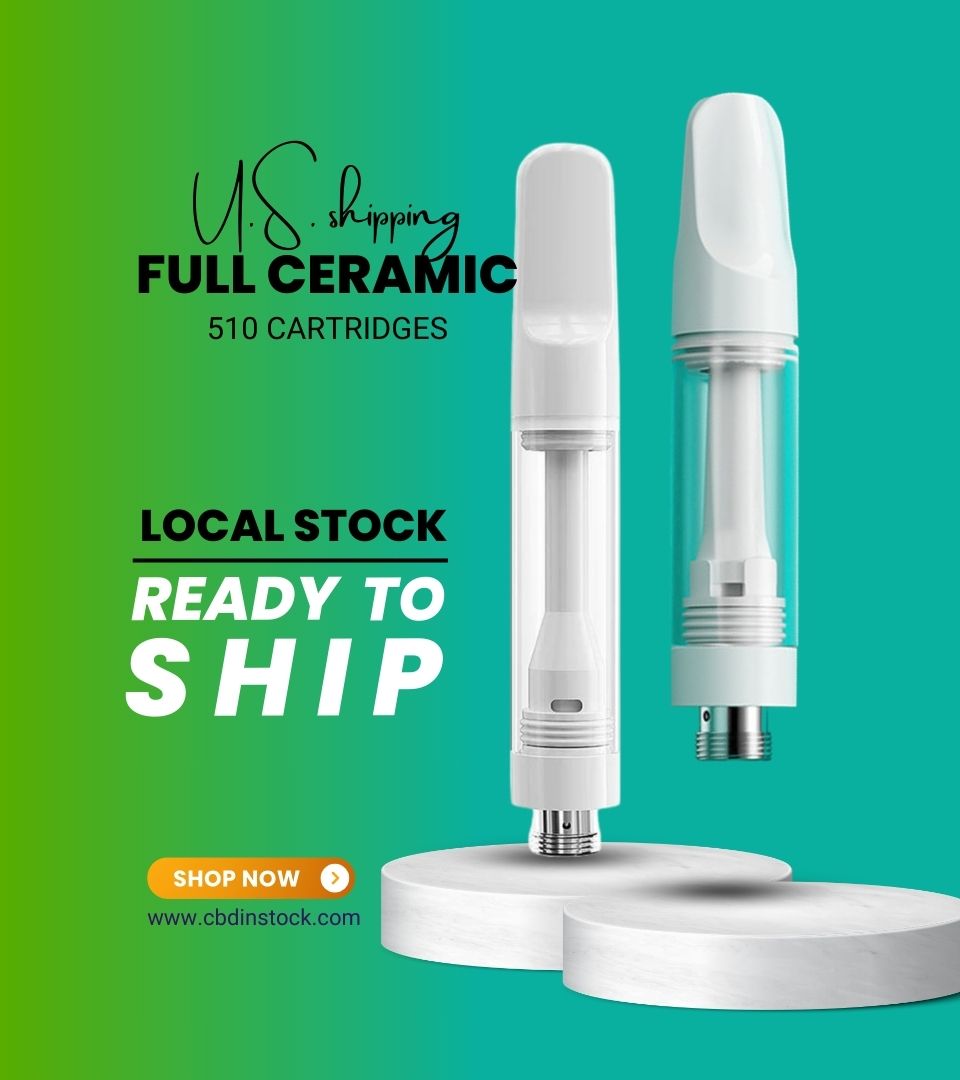
If you’re comparing ceramic vape cartridges against mixed-material options, ask your supplier for the specific ceramic composition, lead-free material certification, and any test documentation they can provide, rather than accepting “full ceramic” as self-explanatory. CBDinstock’s full ceramic cartridge options are offered with full-ceramic and lead-free material choices — the kind of detail worth confirming against your own compliance requirements before it goes into a purchase order.
Comparison: Common Hardware Attributes for Thick-Oil Programs
| Attribute | Why it matters for thick oil | What to request from your supplier |
|---|---|---|
| Intake design | Affects how oil reaches the wick | Photos/drawings of intake count and size |
| Wicking material | Affects saturation consistency across viscosity range | Material spec sheet, lot-to-lot consistency data |
| Mouthpiece attachment | Press-on ceramic vs. threaded can affect seal consistency | Assembly instructions, closure method used |
| Capacity (0.5ml, 1.0ml, 2.0ml) | Must match your fill volume and dose targets exactly | Actual measured fill volume, not nominal capacity |
| Thread type | Confirms compatibility with your battery program | Thread standard confirmation (e.g., standard 510) |
| Material documentation | Supports your own compliance review | Lead-free / material composition documentation |
Matching Capacity and Architecture to Your Product Program
Capacity selection isn’t just about how much oil fits — it’s about how that volume interacts with viscosity, draw expectations, and your fill line’s tolerances.
0.5ml and 1.0ml formats are common for higher-potency, lower-volume SKUs and for brands testing new oil formulations before scaling. Choosing between capacities for a thick-oil program isn’t simply a matter of “smaller is safer” — internal geometry, intake placement, total oil volume, how long a unit is expected to last a customer, and the unit economics of your program all need to be evaluated separately for each SKU. A well-designed 1.0ml cartridge can outperform a poorly designed 0.5ml one, and vice versa. CBDinstock’s FCC01 0.5ml and 1.0ml full ceramic cartridge is built on a standard 510 thread with a press-on ceramic mouthpiece and dual oval intake openings — a spec sheet worth reviewing directly if you’re deciding between the two sizes for a thick-oil SKU.
2.0ml formats suit programs prioritizing shelf presence, longer expected use periods per unit, or reduced per-unit packaging costs. A larger reservoir keeps oil in contact with internal components across more heating cycles, which increases the need to verify wicking stability over the full life of the unit. If you’re evaluating a 2ml 510 cartridge for a thick-oil line, request samples filled to full capacity, not just half-fill demo units, and evaluate draw consistency from the first draw through the last. The FCC20 2.0ml full ceramic cartridge is one option built for this capacity tier and worth benchmarking against alternatives before committing to a production run.
A general rule for thick oil cartridge selection: match chamber size and internal geometry to your actual fill viscosity data and program requirements, not to whichever capacity a competitor happens to use.
Capping and Assembly Compatibility
Filling and sealing hardware correctly depends on more than the cartridge itself — it depends on how well the closure method fits your production line. Some mouthpieces or caps are designed to be seated by hand, others assume a fixture or dedicated assembly equipment, and mismatches here are a common source of inconsistent seals that have nothing to do with the cartridge’s underlying design.
Before scaling a thick-oil SKU, confirm with your supplier whether the cartridge’s closure is intended for hand-pressure assembly, a fixture, or automated production equipment, and request their current assembly instructions in writing. Run your own trial assembly on your actual line — including your fill volume, your ambient conditions, and your operators — rather than assuming a method that worked for a different hardware SKU will transfer directly. Assembly compatibility is a validation step, not an assumption to carry over from a previous supplier or product line.
Sample Approval Protocol Before Ordering in Bulk

No spec sheet substitutes for testing your actual oil in the actual hardware, at the temperature and equipment you’ll use in production. Before placing a bulk empty cartridges order, run samples through this checklist:
- Fill at production temperature. Test at the same temperature your fill line uses, not room temperature — viscosity shifts significantly with heat.
- Check intake saturation time. Time how long it takes oil to visibly reach the wick after filling and resting.
- Run a shelf-hold observation. Store filled samples upright, on their side, and inverted for a set hold period, then visually inspect the mouthpiece and base for any oil that has migrated to the exterior. Record what you observe and when — this is a screening observation, not a certified seal test, and results should be logged against the specific lot.
- Measure actual fill volume. Confirm the cartridge holds the stated capacity within your acceptable tolerance, not just the nominal 0.5ml/1.0ml/2.0ml label.
- Test draw resistance across the batch. Pull from multiple units, not just one, to check for variance in airpath consistency.
- Inspect mouthpiece attachment strength. For press-on ceramic mouthpieces, check for consistent seating and resistance to accidental removal during handling.
- Confirm thread fit across your battery lineup. Test the 510 thread against every battery/device SKU your brand currently ships with, not just one reference unit.
- Check for visible material changes after an extended hold. Note any discoloration, residue, or other visible change at the oil-hardware interface over one to two weeks, and treat any change as a prompt for further supplier discussion rather than a conclusion on its own.
- Verify lot traceability markings. Confirm the sample batch can be traced to a specific production lot for future reference.
- Request material and assembly documentation. Ask for lead-free/material documentation and current assembly instructions to accompany the sample, not just the bulk order.
- Test a cold-chain scenario if relevant. If your distribution involves cold shipping or storage, test samples after a cold cycle to check for viscosity-related wicking delays.
- Get sign-off in writing from QA, not just purchasing. A verbal “looks fine” from a warehouse check isn’t the same as a documented QA approval tied to a specific lot number.
Seals, Gaskets, and Formulation Compatibility
Gaskets and seal components are part of what a supplier should document, not just the cartridge body and wick. Ask which materials are used in the seals and mouthpiece attachment, and request any documentation the supplier has on file for those components. Because oil formulations vary — in terpene content, cutting agents, and viscosity modifiers — how a given seal performs with your formulation should be verified through your own hold-time samples, rather than assumed from a general product description. Build this into the same shelf-hold checks described above, and treat any change you observe at the seal or gasket over time as information to bring back to the supplier rather than a finding to interpret on your own.
Supplier Documentation and Change Control
Once a spec passes sample approval, the next risk is drift — a supplier changing a material source, a mold, or a wicking supplier without notifying you. Before scaling to full production volume, get the following in writing:
- A locked specification sheet covering dimensions, material composition, intake geometry, thread standard, and assembly method, signed off against your approved sample lot.
- A change-notification clause requiring the supplier to disclose any material, mold, or process change before shipping under the same SKU.
- Lot-level documentation so that if a production issue surfaces after distribution, you can trace it back to a specific batch rather than guessing across multiple shipments.
- Reorder sample rights — the ability to request a fresh sample lot periodically, even from an approved supplier, to catch drift that a single initial approval wouldn’t have detected.
If your program requires branding, custom colorways, or a modified intake or mouthpiece configuration, this is also the stage to raise OEM/ODM options with your supplier and get any custom specification documented in writing as part of the same RFQ package — rather than treated as a separate, undocumented side agreement.
Buyers who skip this step often find that the hardware that passed sample approval in month one isn’t identical to what arrives in month six. That’s rarely due to bad faith — it’s usually a supplier-side material substitution that never got flagged upstream. A documented spec with change control closes that gap.
Common Mistakes Buyers Make
- Approving samples at low fill volume only. A 20% fill test doesn’t reveal how the cartridge performs at full capacity, where wicking and seal issues are more likely to surface.
- Testing at room temperature and shipping in winter. Cold-chain viscosity shifts are a common cause of post-launch complaints that sample testing missed.
- Treating “ceramic” as a single spec. Wall thickness, firing quality, and which components are actually ceramic vary between suppliers; two products both labeled “full ceramic” are not automatically equivalent.
- Assuming a closure method transfers between hardware SKUs. A capping approach that worked on one cartridge design doesn’t guarantee the same seal quality on a different one without its own validation.
- Skipping thread compatibility testing across the full battery lineup. A cartridge that fits one battery SKU doesn’t guarantee fit across every device your brand supports.
- Not locking a spec sheet before scaling volume. Verbal or email approval isn’t the same as a signed, versioned specification tied to a lot number.
- Choosing capacity based on shelf appearance alone. A larger chamber that looks better in packaging can underperform a smaller format if the internal geometry wasn’t evaluated for that specific volume and use period.
Getting Started
Matching hardware to a thick-oil program comes down to testing intake geometry, wicking material, capacity, and assembly method against your actual oil and your own production line — not against a spec sheet alone. CBDinstock carries wholesale empty vape cartridges with local stock and sample dispatch available in the U.S. and Canada, which shortens the sample-and-approve cycle described above. If you’re evaluating hardware for an upcoming production run, request samples against your own oil and fill parameters before committing to volume.
FAQs
What’s the difference between a 1ml 510 cartridge and a 2ml 510 cartridge for thick oils?
Capacity is the obvious difference, but the practical questions are internal geometry and expected use period. A 2.0ml chamber holds more oil in contact with internal surfaces for longer, so intake placement and wicking design matter more, not less, at that volume. Test both at full fill before deciding.
Are full ceramic cartridges always better than cotton-wick cartridges for thick oil?
Not universally, and “full ceramic” doesn’t automatically mean every internal component is ceramic. Wicking behavior varies by manufacturer and grade. Compare specific samples rather than assuming a material label guarantees performance.
What does postless mean, and does it matter for thick oils?
A postless 510 cartridge omits the internal metal connection post from the airpath. Some processors find this simplifies assembly and reduces internal obstruction, but the practical effect on your specific oil should be confirmed with side-by-side sample testing.
How many samples should we test before placing a bulk order?
Test enough units to see lot variance, not just a single sample — typically a mix from different points in a sample batch, filled at full capacity and tested under both room-temperature and cold-chain conditions if relevant to your distribution.
Do we need to validate the capping or sealing method separately from the cartridge itself?
Yes. Whether a closure needs hand pressure, a fixture, or dedicated assembly equipment depends on the specific hardware and your line, not on a general standard. Request the supplier’s current assembly instructions and run your own trial before scaling.
Can we request custom intake, mouthpiece, or branding configurations for a thick-oil SKU?
Many suppliers offer OEM/ODM options at sufficient order volume. Raise these during the RFQ stage and get any custom configuration documented in the specification, alongside your standard hardware requirements.
What documentation should we request before scaling from sample to bulk order?
At minimum, a locked specification sheet, material documentation, lot traceability information, current assembly instructions, and a change-notification agreement covering future material or process changes. Compliance and certification requirements vary by jurisdiction and product program, so align any documentation request with your own compliance team before finalizing an order.