
The most expensive cartridge is not automatically the best cartridge for a product line. Neither is the one with the longest feature list. For buyers comparing ceramic vs metal hardware, the better choice is the cartridge that remains consistent after filling, capping, shipping, storage and repeated use with the brand’s actual formulation.
That is why the full-ceramic-versus-metal discussion needs more precision than “premium” versus “standard.” Depending on the model, a full ceramic cartridge may change the oil-contact materials, the central structure or both. It does not remove the need to match the atomizer, intake geometry, resistance and operating voltage to the oil.
This guide compares both formats from a production and procurement perspective. It is intended for brands evaluating empty hardware—not for consumers trying to choose a prefilled product.
The Short Answer
Choose a full ceramic design when its material presentation, open-tank appearance and positioning support a premium product—and when the model under consideration passes testing with your oil and filling process.
Choose a well-made metal-center-post cartridge when mechanical tolerance, familiar production handling and cost control matter more—and when its wetted materials and finished-unit results meet your requirements.
In either case, do not approve a purchase order from the material label alone. Run a controlled pilot with the same oil, fill weight, capping method, battery settings and storage conditions planned for production.
What “Full Ceramic” Actually Means
The phrase is used inconsistently across the hardware market. Some cartridges have a ceramic mouthpiece and ceramic heating core but retain a metal center post. Others replace the visible center post with ceramic. In most postless designs, the central column is removed and the airflow and electrical paths are rerouted through the base or body; the exact implementation still needs to be confirmed on the model-specific drawing.
Before comparing quotes, ask the supplier to identify every material that can contact the formulation. That list may include the tank wall, seals, atomizer housing, intake structure, mouthpiece interior and base components. A product name is not a bill of materials.
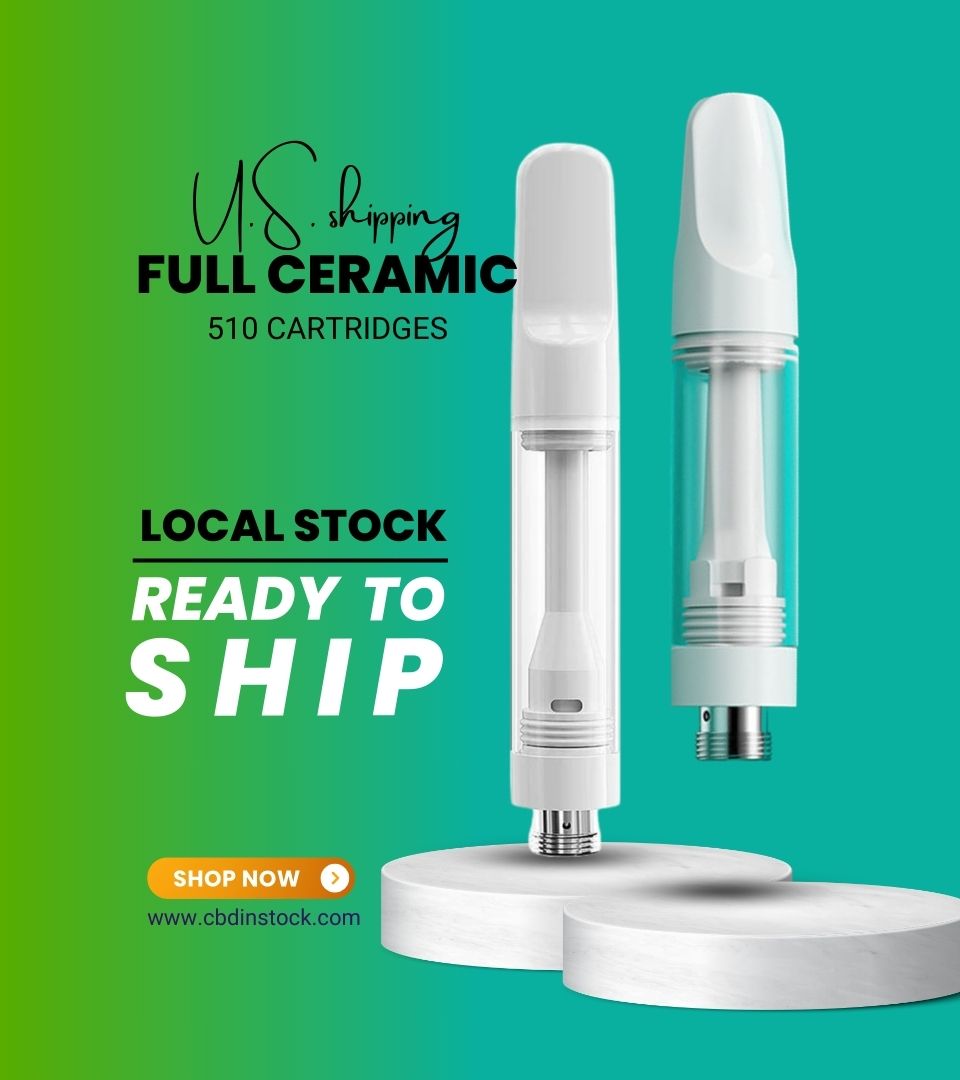
CBD INSTOCK’s full ceramic cartridges category is the appropriate starting point for available ceramic 510 formats. For any shortlisted model, request the model-specific drawing, material details and filling guidance rather than assuming that every cartridge in the category has identical construction.
What a Metal Center Post Does
In a conventional 510 cartridge, the center post contributes to the mechanical and electrical structure of the assembly and, in some designs, also shapes part of the airflow channel. Quality models commonly use stainless steel or another specified alloy. Metal content alone says nothing about how a cartridge will run a specific oil.
The atomizer still has to receive oil at a suitable rate, and the seals have to hold through temperature changes. Condensation must be managed in the airway, while the battery has to run within its intended range. A properly matched traditional cartridge can outperform a poorly matched all-ceramic one—and a properly matched ceramic design can outperform a poorly matched traditional one.
Buyers weighing this option against ceramic formats can compare CBD INSTOCK’s traditional 510 cartridges directly.
Ceramic vs. Metal Cartridges: The Differences That Matter to Buyers
| Buying factor | Full ceramic or ceramic-path design | Metal-center-post design |
|---|---|---|
| Product presentation | Distinctive ceramic components—often pale or white, though colored finishes exist—and a premium visual story | Familiar 510 appearance with broad style and finish options |
| Oil-contact materials | Can reduce or remove exposed metal from parts of the oil path; verify the complete material list | Includes a specified metal post plus seals, tank and atomizer components |
| Mechanical behavior | Ceramic parts can require more careful handling and controlled capping force | Metal structural parts are generally more tolerant of routine line handling |
| Production changeover | Fill opening, headspace and capping procedure may differ by model | Often familiar to teams already running standard 510 hardware |
| Cost | Commonly positioned at a premium | Usually offers more cost-oriented configurations |
| Performance | Depends on atomizer, intake, airflow, voltage and oil match | Depends on the same system variables |
This table describes common tendencies, not universal specifications. Model-to-model differences can be larger than the difference between the two labels.

Oil Compatibility Comes Before Material Preference
Viscosity is not a fixed number printed on a formulation forever. It changes with temperature, cannabinoid concentration, terpene content and other formulation choices. The oil that fills smoothly while warm may move very slowly after a cold delivery or storage cycle.
That makes intake and atomizer matching central to the purchase decision. If oil reaches the heating zone too slowly, the cartridge can produce weak output or a dry note. If it enters faster than the system can vaporize it, excess oil may contribute to flooding, gurgling or airway blockage. Changing the center-post material does not automatically correct either mismatch.
Brands handling viscous formulations should compare multiple intake layouts and capacities instead of limiting the sample set to one material story.
Does Full Ceramic Automatically Mean Better Flavor?
No single hardware label guarantees flavor performance. The formulation itself, heating profile, atomizer design, airflow and battery output all influence the sensory result. A full ceramic model may work extremely well for a terpene-forward product, but that result should come from a blind or controlled comparison—not from the word “ceramic” on a quotation.
For a useful bench comparison, fill both candidates from the same prepared oil lot. Use compatible batteries at the specified voltage, follow the same rest period and evaluate samples at comparable stages of the cartridge life. Record first-use behavior, mid-life consistency and end-of-fill performance. If different atomizers or airflow systems are involved, document that the test compares complete systems rather than a single material.
Does Full Ceramic Prevent Clogs or Leaks?
It should not be marketed as clog-proof or leak-proof. Clogs can involve condensation, oil entering the airway, an atomizer-flow mismatch, temperature exposure or user draw patterns. Leaks can involve seal tolerances, filling temperature, capping delay, headspace, pressure changes and physical damage.
Architecture matters, but it is one part of a system. Postless and ceramic designs can change reservoir layout, airflow and pressure behavior; those changes need validation. The practical question is not “Can this type leak?” Every hardware type can fail under the wrong conditions. The useful question is “What failure rate does this exact filled configuration show under our test protocol?”
Production Handling: Where Good Samples Can Fail at Scale
A five-unit desk test cannot reproduce a production run. Before changing hardware, verify that the cartridge fits the filler, fixture, capper, trays and packaging already used on the line.
Fill Opening and Needle Access
Measure the usable opening after accounting for the central structure. Confirm that the production needle can enter without touching the airway or tank wall. A postless tank may provide a different access path, but it can also require a revised fixture or fill position.
Headspace and Fill Weight
Nominal capacity and recommended fill weight are not always interchangeable. The correct target needs room for components displaced during capping and for pressure behavior after assembly. Establish fill weight from the supplier’s instructions and your own leak-aging results.
Capping Force and Timing
Ceramic components are hard but can be brittle. A capping process that was acceptable for a metal-supported design may apply force differently to a ceramic assembly. Confirm alignment, force or torque limits, and the maximum recommended interval between filling and final capping.
For a complete production sequence, see How to Fill 510 Cartridges for Consistent Production.
Line-Clearance and Breakage Plan
If a ceramic component chips or breaks on the line, stop and define how nearby open units will be segregated. Trays should prevent cartridges from striking each other, and operators should know which cosmetic marks are acceptable and which require rejection.
Durability and Distribution Testing

Cartridges do not travel from a quiet bench directly into a customer’s hand. They move through capping equipment, packing stations, parcel networks, hot vehicles and cold storage areas. Material selection should therefore include the package and shipping environment.
At minimum, test filled and capped units across:
- upright, inverted and horizontal storage;
- normal room conditions plus planned hot and cold excursions;
- vibration or transport simulation in the final retail package;
- repeated connection to representative 510 batteries;
- controlled drops in the final package, when appropriate;
- aging checkpoints rather than a single next-day inspection.
Record leakage by location, not just pass or fail. Oil at an intake, base seal, mouthpiece and airway can indicate different causes. Photograph failures and retain lot numbers so the supplier can investigate the relevant component batch.
Compliance Questions Require Documents, Not Marketing Claims
Neither “ceramic” nor “stainless steel” is a compliance certificate. Requirements vary by market and product, so the brand’s compliance team should define the necessary test scope and acceptance criteria.
Ask for material declarations, available component or finished-hardware test reports, manufacturing traceability and change-control procedures. Then determine whether testing must be repeated on the finished, filled unit. Hardware results from an empty component may not answer every question about the final formulation, storage time and operating conditions.
Avoid absolute statements such as “zero heavy metals” unless the claim is supported by the correct analytical method, detection limits, sample type and current production lot. A more defensible purchasing process verifies specified materials and tests the finished configuration under the rules that apply to the target market.
Cost Is More Than Unit Price
The quotation is only the first line of the cost model. A lower-price cartridge can become expensive if it adds rework, leakage, breakage, customer replacements or slow line speed. A premium ceramic cartridge can also be the wrong investment if its visual or material difference adds no value to the intended product tier.
Calculate the expected cost per saleable unit:
landed hardware + filling labor + expected scrap + rework + packaging changes + complaint allowance
Run the calculation for the pilot and again after a representative production batch. If the business case depends on a lower complaint rate, require enough observations to support that assumption.
A Practical Sample-Approval Protocol
The following protocol keeps a comparison focused on repeatable evidence.
1. Define the Product Before Requesting Samples
Share the intended capacity, oil family, expected viscosity range or temperature-dependent behavior, fill method, capping equipment, battery range, package format, target market and forecast volume. A supplier cannot recommend intelligently from “1 mL ceramic cart” alone.
2. Compare at Least Two Suitable Architectures
Do not set up a ceremonial test in which one candidate is already known to be incompatible. Select a full ceramic or postless candidate and a high-quality metal-post candidate that are both designed for the formulation.
3. Lock the Test Variables
Use the same oil lot, preparation method, fill temperature, fill weight, capping interval, rest time, storage orientation and battery setting. Label every unit so results remain traceable.
4. Observe the Entire Use Cycle
Check appearance and mass after filling, then inspect at planned aging points. Evaluate startup, repeated use, mid-life performance and remaining-oil behavior. A cartridge that performs well for the first few draws may not stay consistent.
5. Define Approval Criteria in Advance
Set thresholds for fill-weight variation, visible leakage, breakage, electrical failures, airflow complaints and sensory consistency before seeing the result. Predetermined criteria reduce the temptation to explain away a favored sample’s failures.
6. Confirm the Production Unit
Make sure the approved sample and the purchase-order item share the same drawing, atomizer specification, resistance range, materials and capping method. Record the version and require notice before material or process changes.
Questions to Ask a Cartridge Supplier
Use these questions in a sourcing call or RFQ:
- What does “full ceramic” mean for this exact model?
- Which components contact the oil, and what are their specified materials?
- What oil types and operating range was the atomizer designed for?
- What are the recommended fill temperature, fill weight, headspace and capping limits?
- Is the mouthpiece press-fit, snap-on or threaded, and can our equipment control the required force or torque?
- What resistance tolerance and battery voltage range are specified?
- Which test reports apply to this specific SKU and production version?
- How are lots identified, and how are engineering changes communicated?
- What pilot quantity is available before a bulk order?
- Which packaging method is recommended to protect ceramic components in transit?
When purchase volume, customization and delivery planning become the main questions, CBD INSTOCK’s wholesale disposable vapes and empty carts page provides the appropriate commercial inquiry route.
Which Cartridge Should Your Brand Choose?
Full Ceramic Is a Strong Candidate When
- the material architecture supports the product’s premium positioning;
- the open or ceramic visual design is important to brand presentation;
- the exact model is compatible with the formulation and production line;
- the package protects ceramic parts through distribution;
- documentation and finished-unit testing meet the target market’s requirements.
A Metal-Center-Post Cartridge Is a Strong Candidate When
- the brand needs a proven, cost-controlled 510 format;
- production equipment and SOPs are already validated around that construction;
- mechanical robustness is a priority;
- specified wetted materials and finished-unit testing are acceptable;
- the complete oil-hardware system outperforms alternatives in the pilot.
Many brands do not need one architecture for every SKU. A premium extract line and a value-oriented distillate line may justify different hardware—provided each combination is tested and managed as its own finished product.
Final Takeaway
Full ceramic cartridges are a meaningful design option, not a shortcut around engineering. Their material presentation and architecture can fit premium products very well, while traditional metal-center-post cartridges can offer reliable production handling and strong cost control. Neither label guarantees flavor, leak resistance or clog resistance on its own.
The best sourcing decision is the one supported by a clear material definition, oil-specific samples, controlled production trials and finished-unit aging data. Start with the product you intend to fill, then choose the cartridge that proves it can carry that product consistently.
Frequently Asked Questions
What Is the Difference Between Full Ceramic and Metal-Center-Post Cartridges?
Full ceramic models replace or remove selected metal structures in the oil path, while conventional cartridges retain a specified metal center post. Ceramic designs often carry a price premium and may need tighter handling controls; traditional designs are familiar on many production lines. Neither architecture is automatically better—the oil, atomizer, airflow, voltage and finished-unit test results determine the fit.
Are full ceramic cartridges completely metal-free?
Not necessarily. The phrase may describe the center post, atomizer housing, mouthpiece or oil path, while electrical contacts or base components can still contain metal. Ask for the complete material list for the exact model.
Are ceramic 510 cartridges compatible with every battery?
The 510 connection is widely used, but physical clearance, resistance and recommended voltage still vary. Test the cartridge with representative batteries and follow the hardware supplier’s operating range.
Are full ceramic cartridges better for thick oil?
They can be designed for thick formulations, but ceramic construction alone does not establish compatibility. Atomizer porosity, intake geometry, oil behavior at expected temperatures and voltage all matter.
Can the same filling settings be used after switching cartridge styles?
Do not assume so. Confirm needle access, oil temperature, fill weight, headspace, capping timing and capping force for the new model, then validate them in a pilot.
How many samples should a brand test?
There is no universal number. Use enough units and production lots to observe the failure modes that matter to the business, and have the quality team set a statistically appropriate plan for the forecast volume and risk level.